The Power of Floorstanding Speakers
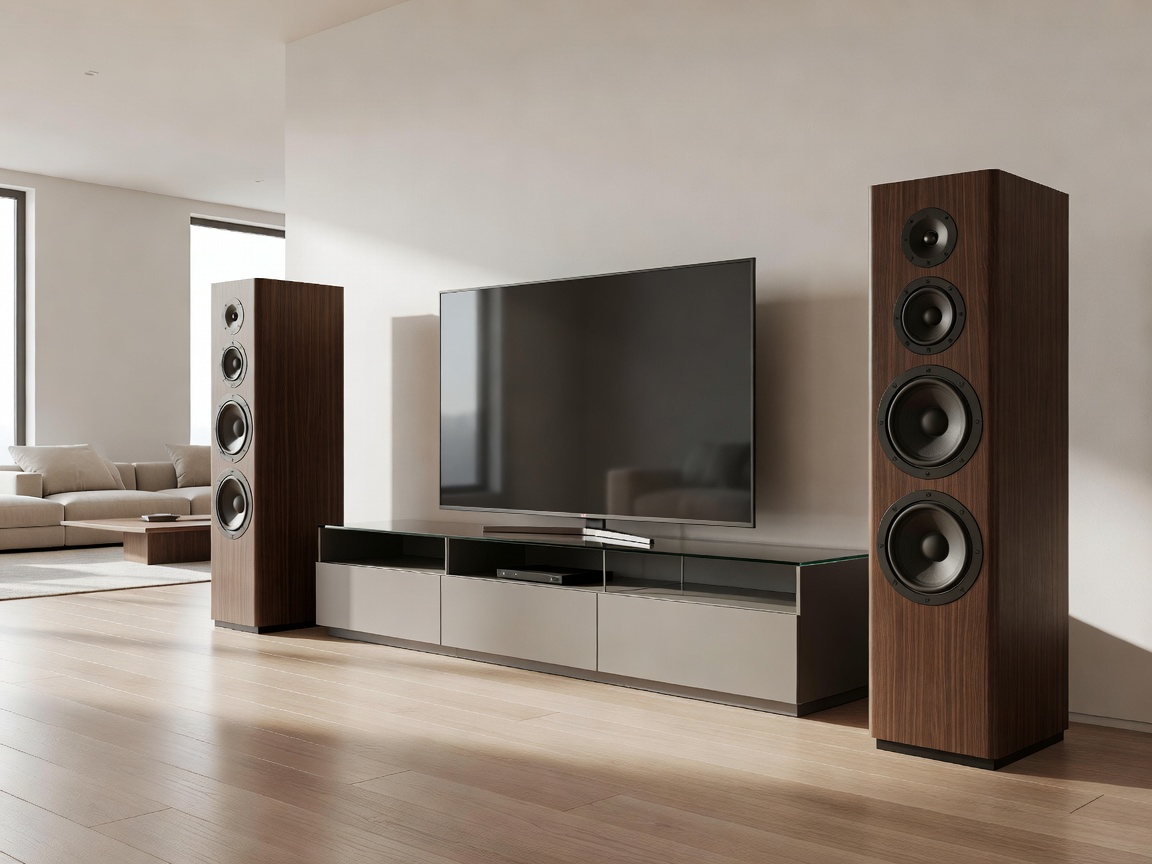
Floorstanding speakers, frequently referred to as tower speakers, are the undisputed anchors of high-fidelity stereo systems and premium home theater setups. Thanks to their large internal cabinet volumes and multiple driver configurations, they are capable of delivering a massive, full-frequency soundstage that can fill large listening spaces with ease.
Why Cabinet Volume Matters
To produce deep, resonant bass, a speaker driver must move a substantial amount of air. The large cabinet of a floorstanding speaker acts as an acoustic suspension or bass reflex system, providing the necessary internal volume for large woofers (often 6.5 to 8 inches or larger) to travel efficiently.
Many modern towers utilize a bass reflex port (a tuned hole in the front, back, or bottom of the cabinet) to reinforce low-frequency output. By tuning the port to a specific frequency, speaker designers can significantly lower the overall bass response of the system without requiring astronomically large drivers.
2-Way vs. 3-Way vs. 4-Way Designs
While most bookshelf speakers are 2-way designs, the added real estate on a tower speaker's baffle allows for more complex driver arrays:
- 2-Way Towers: Utilize a tweeter and one or more mid/bass woofers. They often parallel multiple woofers to move more air, but the woofers still handle both midrange and bass.
- 3-Way Towers: The gold standard for many audiophiles. These feature a dedicated tweeter for highs, a dedicated midrange driver for vocals and primary instrumentation, and dedicated woofers purely for bass. This separation significantly reduces distortion, as the midrange driver isn't struggling to reproduce massive bass notes at the same time.
- 4-Way Towers: Found in ultra-high-end systems, introducing a "super-tweeter" for extreme high frequencies or splitting the bass duties between mid-bass and sub-bass drivers.
Amplification Needs
It is a common misconception that large speakers are harder to drive. In many cases, floorstanding speakers are actually more efficient (having a higher sensitivity rating, measured in decibels) than small bookshelf speakers. A sensitivity rating of 90dB or higher means the speaker can produce significant volume from a relatively modest amplifier.
However, because towers are capable of rendering huge dynamic swings—from a whisper-quiet violin to an explosive orchestral crescendo—they benefit greatly from amplifiers with high-current power supplies that can control the large woofers accurately.
Positioning in the Room
Floorstanding speakers demand careful placement. Because they output significant low-frequency energy, placing them too close to corners can result in "boundary gain," artificially inflating the bass and making the system sound boomy. It is highly recommended to keep them at least two feet away from the side walls and front walls to preserve the clarity of the midrange and the tightness of the bass.
Pros and Cons
| Advantages | Disadvantages |
|---|---|
| Exceptional, deep bass response without needing a subwoofer. | Large physical footprint dictates room layout. |
| High sensitivity; can play very loud with minimal distortion. | Heavy and difficult to move or reposition. |
| Dedicated midrange drivers provide unparalleled vocal clarity. | Typically more expensive to manufacture and ship. |
| Visually striking, acting as a centerpiece for the room. | Can overwhelm small rooms with excessive bass energy. |
Final Thoughts
If you have the physical space and a desire for uncompromised, full-range audio, floorstanding speakers are unmatched. They provide a physical, tactile listening experience where you do not just hear the music—you feel it. When integrated properly into a room, a pair of premium towers can recreate the scale and dynamics of a live performance in your own home.